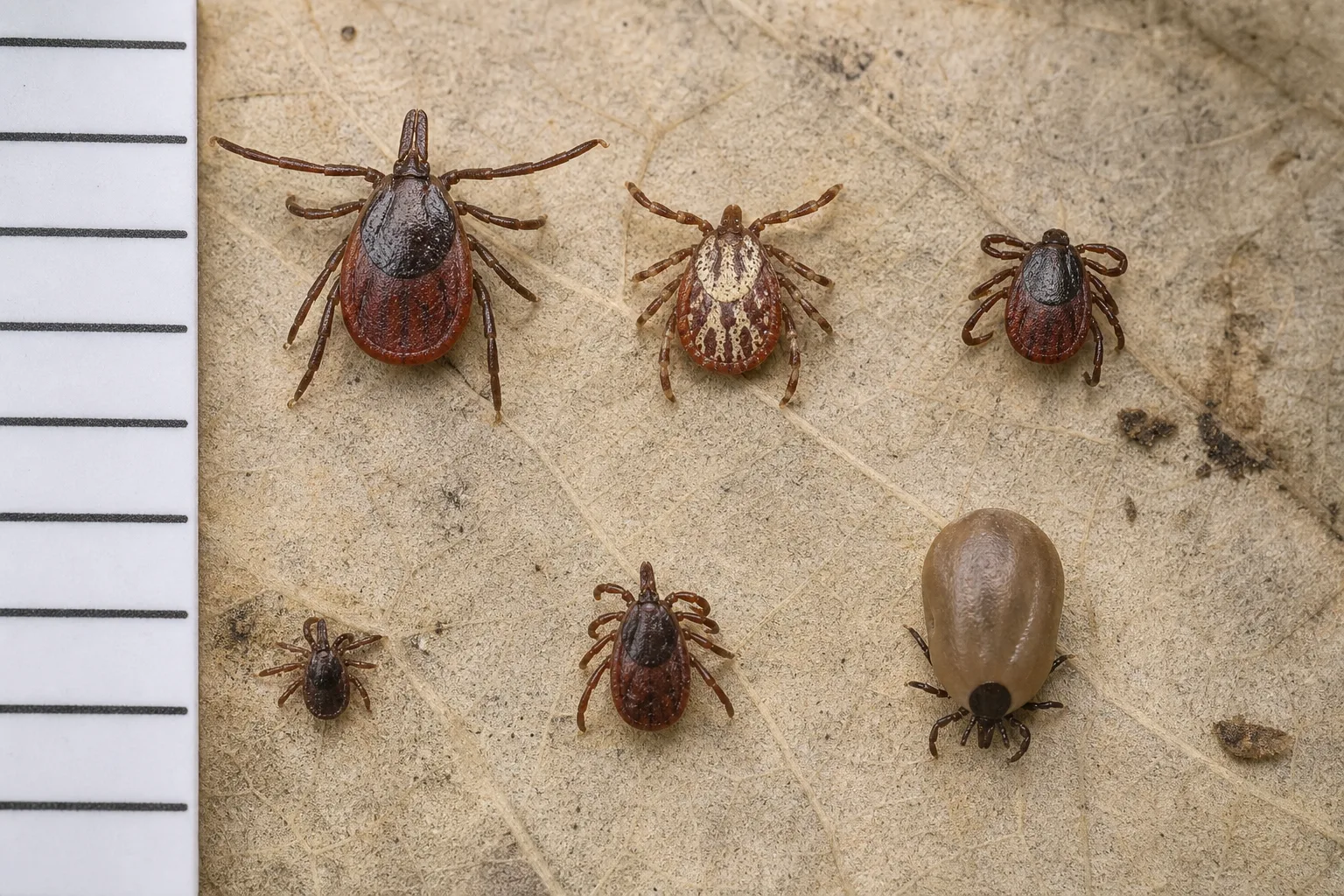
Common types of ticks can often be narrowed down by a combination of body markings, mouthparts, life stage, where the tick was found, and the host it was on. A photo can be useful for an initial match, but it cannot show whether a tick carries a pathogen. Species identification and disease risk are related, but they are not the same question. Source (accessed 2025-03-08)
Start with the tick’s life stage and visible features
Ticks develop through larval, nymphal, and adult stages. Larvae are especially easy to miss, nymphs may be very small and lack obvious adult markings, and adult females can change shape substantially after feeding. For a useful identification photo, show the tick from above, place it beside a familiar object for scale, and avoid crushing it. Source (accessed 2025-03-08)
- Shape: Look for an oval, flattened body before feeding; an attached or fed tick may appear rounded or swollen.
- Markings: Note a pale dot, pale edge pattern, silvery ornamentation, or an unmarked reddish-brown body.
- Mouthparts: Longer, more visible mouthparts can help separate some species, including blacklegged and lone star ticks, from many dog ticks.
- Location: State, county, habitat, season, and host are often as useful as color. Tick ranges and local surveillance can change over time.
Use a clear top-view photo as one part of identification, not as a medical test. A trained identifier may need details that are obscured in a blurred, engorged, damaged, or side-view image. Source (accessed 2025-03-08)
A practical way to narrow down types of ticks
- Record where it was found. A tick collected indoors, from a dog, from a wooded trail, or from tall grass may point to different likely species.
- Check for a signature marking. A single pale spot suggests a female lone star tick; pale patterned ornamentation may suggest an American dog, Rocky Mountain wood, or Gulf Coast tick.
- Compare mouthparts and color. An adult female blacklegged tick usually has a dark shield near the head with a reddish-orange rear body. An unfed brown dog tick is more uniformly brown.
- Account for feeding. Do not identify an attached, swollen tick by body size alone. Feeding can hide normal color and proportions.
- Confirm when the result matters. If the tick was attached, symptoms develop, or a veterinarian or clinician needs the species, retain the specimen or use an authoritative identification service.
For close-up visual cues, see what a tick looks like and tick markings that can help distinguish species.
Common tick species and what distinguishes them
Blacklegged tick, also called deer tick
Blacklegged ticks are important in eastern and upper midwestern areas of the United States; a related western blacklegged tick is important on the Pacific Coast. Adult females commonly show a dark area near the head and a reddish-orange rear body, while males appear darker overall. Nymphs are much less distinctive and are easily confused with other small ticks. Blacklegged ticks are associated with Lyme disease, anaplasmosis, babesiosis, and Powassan disease in relevant regions. An association does not mean an individual tick is infected or that a bite causes illness. Source (accessed 2025-03-08)
Lone star tick
The adult female lone star tick may have one conspicuous pale spot on its back. Adults and nymphs can bite people and pets, and lone star ticks are encountered in brushy, wooded, and grassy habitats in much of the eastern and southern United States. They are associated with ehrlichiosis and with alpha-gal syndrome, an allergy that can follow some tick bites. Neither a white spot nor a bite alone can diagnose a health condition. Source (accessed 2025-03-08)
American dog tick
American dog ticks are relatively broad-bodied and may have pale or silvery-looking markings across the upper body. They are often found in grassy, open, or brushy places and may be found on dogs as well as people. They are associated with Rocky Mountain spotted fever in parts of their range. Similar-looking ornate ticks can occur in the same general areas, so location and a clear view of the scutum, the shield-like area behind the head, matter. Source (accessed 2025-03-08)
Brown dog tick
Brown dog ticks are usually more uniformly reddish-brown than ornate dog ticks. Unlike many ticks that are chiefly encountered outdoors, brown dog ticks can complete their life cycle in and around buildings where dogs are present. Finding repeated ticks indoors or on a dog warrants veterinary and pest-management advice targeted to the home and pet environment. Source (accessed 2025-03-08)
Rocky Mountain wood tick
Rocky Mountain wood ticks are an ornate species associated with the western United States. Their pale patterned upper surface can resemble the American dog tick, so a state-level location is valuable for a probable identification. Public-health relevance is regional; a photo should not be used to infer whether the tick carried a pathogen. Source (accessed 2025-03-08)
Gulf Coast tick
Gulf Coast ticks are another patterned tick that can be confused with dog ticks. They are most relevant in Gulf and Atlantic coastal areas, though their distribution is not limited to a single shoreline. When markings are visible, compare the entire pattern rather than relying on one pale patch. For a focused comparison, see the Gulf Coast tick identification guide. Source (accessed 2025-03-08)
Winter tick
Winter ticks are often associated with large wildlife hosts, especially deer and moose. They may appear on people or domestic animals, but an encounter does not automatically make them the leading explanation for a human illness. Host, region, and season help distinguish a likely winter tick encounter from a dog-tick or blacklegged-tick encounter. Source (accessed 2025-03-08)
Asian longhorned tick
Asian longhorned ticks are an introduced species of growing surveillance interest in the United States. They can resemble other brown ticks in photographs, particularly when small or fed. Because range and surveillance information can change, use current state or local agriculture and public-health guidance when this species is suspected. Source (accessed 2025-03-08)
Which ticks should concern people or pets?
Any attached tick deserves careful removal and follow-up, but concern is not determined by appearance alone. The medically relevant question is whether the species occurs locally, whether it can transmit a particular pathogen in that area, how long it may have been attached, and whether symptoms occur afterward. The same principle applies to dogs: identifying the tick can help a veterinarian consider local risks, but it does not diagnose a pet. Source (accessed 2025-03-08)
Blacklegged ticks are the principal Lyme disease concern in the regions where they occur. Lone star ticks, dog ticks, and other species can be associated with different conditions. Do not assume that a tick commonly called a “deer tick” or “dog tick” can be identified accurately from its host alone. Source (accessed 2025-03-08)
If you find an attached tick
- Remove it promptly with clean, fine-tipped tweezers, grasping close to the skin and pulling steadily upward.
- Clean the bite area and your hands after removal.
- Take clear photos before disposal, or keep the tick in a sealed container if a clinician, veterinarian, or local authority may need to inspect it.
- Note the date, location, likely exposure setting, and whether the tick was attached to a person or pet.
- Contact a clinician or veterinarian promptly for concerning symptoms, a spreading rash, fever, illness, or questions specific to local tick-borne disease risk.
Tick testing and species identification can answer different questions. A result from a tick does not by itself establish whether a person or pet will become ill, so medical or veterinary decisions should include symptoms and local guidance. Source (accessed 2025-03-08)
For pet-specific next steps, read which ticks bite dogs and what an engorged tick on a dog can mean. If you have a usable photo, Ticky can help you compare visible traits for an initial identification; preserve the original image and treat the result as a starting point when health decisions are involved.
Can a tick be identified from a photograph?
Often, a sharp top-view image plus location and host information can support a likely identification. Identification is less reliable when the tick is fed, damaged, very small, or photographed from the side. Expert examination may be needed when the distinction affects health, veterinary, surveillance, or pest-control decisions. Source (accessed 2025-03-08)
How can I tell a deer tick from a dog tick?
An adult female blacklegged tick typically has a dark front shield with a reddish-orange rear body and comparatively prominent mouthparts. American dog ticks are broader and commonly have pale ornamental markings. Nymphs, fed ticks, and poor photographs are harder to separate reliably. Source (accessed 2025-03-08)