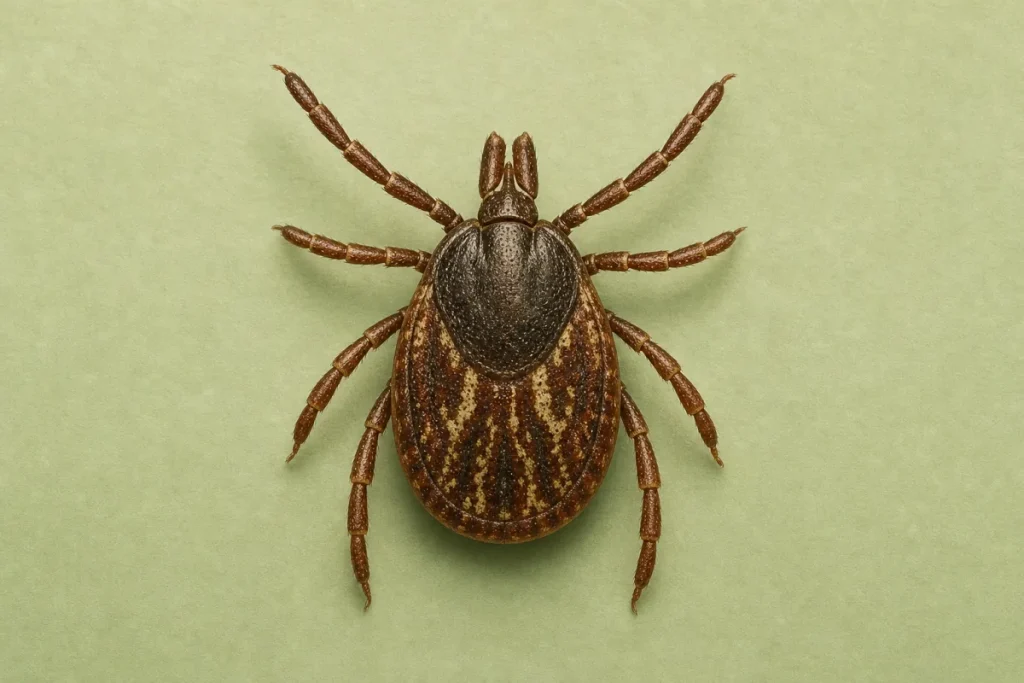
No—ticks do not have antennae. Ticks are arachnids rather than insects. A tick may have forward-pointing mouthparts or raised front legs that look antenna-like at a glance, but neither structure is an antenna. Source (accessed 2026-11-19)
That single clue is useful, but it is not enough by itself. Small arthropods move quickly, photos can blur fine structures, and a young tick does not have the same leg count as an older one. The most reliable first pass is to look at antennae, leg count, body shape, and where the legs join the body together.
Why a tick can look as if it has antennae
On a tick, the feeding structures sit at the front of the body. Depending on the viewing angle, those mouthparts can appear as short projections. The front pair of legs may also be held forward while the tick is moving. That posture can make a tick look more insect-like than it is.
True antennae are a paired sensory structure found on insects. In contrast, a tick’s front legs are legs: they arise from the body with the other legs and are jointed. If the long projections connect in the same general row as the other walking legs, they are more likely to be legs than antennae. Ticks also lack wings. Source (accessed 2026-11-19)
Tick or insect: use several visible clues
| Feature | Typical tick | Typical insect |
|---|---|---|
| Antennae | Absent | One pair is present |
| Body appearance | Compact, with a broadly fused appearance | Usually shows a head, thorax, and abdomen |
| Wings | Absent | May be present, depending on the insect |
| Legs after the larval stage | 8 | 6 |
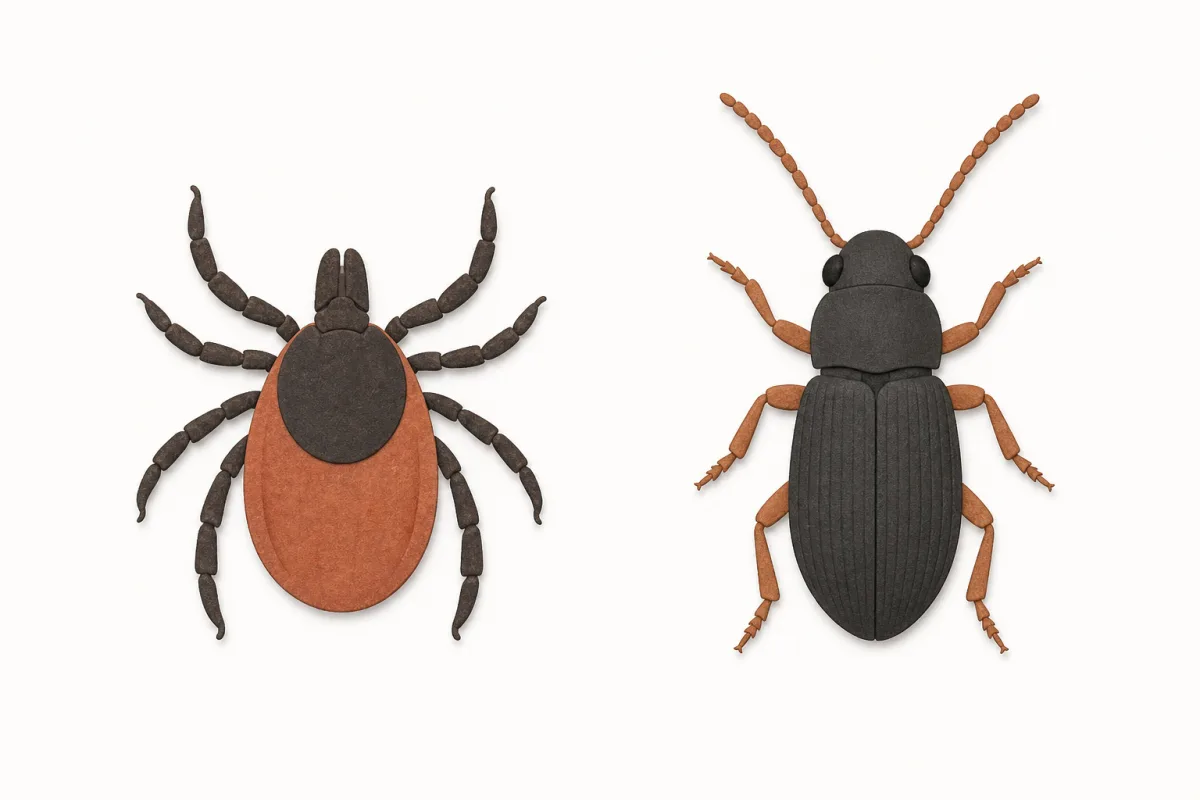
Adult ticks have 8 legs, no antennae, and a body plan unlike the three clearly defined body regions typical of insects. Adult insects have 6 legs and one pair of antennae. Source (accessed 2026-11-19)
A six-legged specimen can still be a tick
A larval tick has 6 legs. After that early stage, nymphs and adults have 8 legs. So, six legs do not automatically mean “insect”; antennae and the overall body structure still matter. Source (accessed 2026-11-19)
If you are trying to assess a very small arthropod, see our tiny tick guide for size-aware observation tips. A close, well-lit image is usually more useful than trying to identify it from color alone.
Lookalikes with antennae are not ticks
Many creatures that people casually call “ticks” are insects or other arthropods. A small beetle, a bed bug, or a weevil may look tick-like because it is oval or brown, yet visible antennae are a strong reason to reconsider the identification. Insects also commonly show clearer body divisions than ticks do.
Do not rely on whether an animal is found indoors, on a pet, or on clothing. Those circumstances can be helpful context, but they do not replace visible anatomy. For a broader visual reference, compare your observation with the features in what a tick looks like and common tick types.
Assessing a suspected tick from a photo
Start with the sharpest image available and zoom in without over-enlarging it. Try to capture the whole arthropod from above, plus a side angle if possible. Look for a pair of antennae before deciding it is a tick. Then count visible legs carefully, remembering that a larva has 6 legs while nymphs and adults have 8. Source (accessed 2026-11-19)
Photo-based identification is best treated as a screening step. Shadows, damaged specimens, and legs tucked under the body can conceal important features. Include a neutral object for scale if you can, but avoid handling an attached arthropod just to obtain a better photo. If the question is whether a specimen could be a tick, our tick check guide can help you organize what to look for on skin, clothing, and pets.

Our take: antennae beat color as an early clue
Our take: When a small crawling animal has obvious antennae, we would pause before calling it a tick. Color is too variable and camera-dependent to carry much weight, while antennae, leg placement, and body structure answer the basic tick-versus-insect question more directly. We would not bother trying to name a tick species from a blurry image before first confirming that the animal is likely a tick.
Missteps that make tick identification harder
- Counting only the legs you can immediately see. Legs may be hidden under the body or lost in a blurred image; this can turn an uncertain observation into a false insect label.
- Treating front legs as antennae. A forward-facing tick can look misleadingly insect-like, so check where each projection joins the body.
- Using color as the deciding feature. Lighting, feeding state, and image quality can change apparent color; this costs you the more dependable structural clues.
- Assuming every six-legged crawler is an insect. This overlooks the larval tick stage and can end the check too early. Source (accessed 2026-11-19)
If a tick is attached or you think you were bitten
Identification and health decisions are related but separate. If a tick is attached, the CDC advises removing it promptly with clean, fine-tipped tweezers, grasping close to the skin and pulling upward with steady pressure. After removal, clean the bite area and your hands. Source (accessed 2026-11-19)
Pay attention to changes after a bite. CDC guidance says to contact a healthcare provider if you develop a rash, fever, or other symptoms after a tick bite. A photo can help document what you found, but it cannot diagnose illness or determine whether a tick carried a pathogen. Source (accessed 2026-11-19)
The points worth remembering before you label it a tick
- Ticks do not have antennae, so obvious antennae point more strongly toward an insect or another lookalike.
- A larval tick has 6 legs, while nymphs and adults have 8, so leg count needs to be interpreted with life stage in mind. Source (accessed 2026-11-19)
- Forward-facing mouthparts and front legs can be mistaken for antennae, especially in a small or blurry photo.
- Use several structural clues together—antennae, legs, body form, and wings—rather than relying on color or location.
- An attached tick or symptoms after a bite deserve prompt, practical follow-up even when the identification remains uncertain. Source (accessed 2026-11-19)
Questions people ask about tick antennae
Do ticks have a separate head and abdomen like insects?
Ticks have a more compact, fused-looking body plan than insects. Insects typically show a head, thorax, and abdomen, while ticks do not present those regions in the same obvious way. Source (accessed 2026-11-19)
Can a tick have wings?
No. Ticks do not have wings. Wings, particularly alongside obvious antennae and a clearly segmented insect body, are evidence that you are looking at something other than a tick. Source (accessed 2026-11-19)
What should I photograph for a better identification?
Photograph the full animal in focus from above, include the front end and legs, and add a second angle when possible. Clear structure matters more than an extreme close crop.