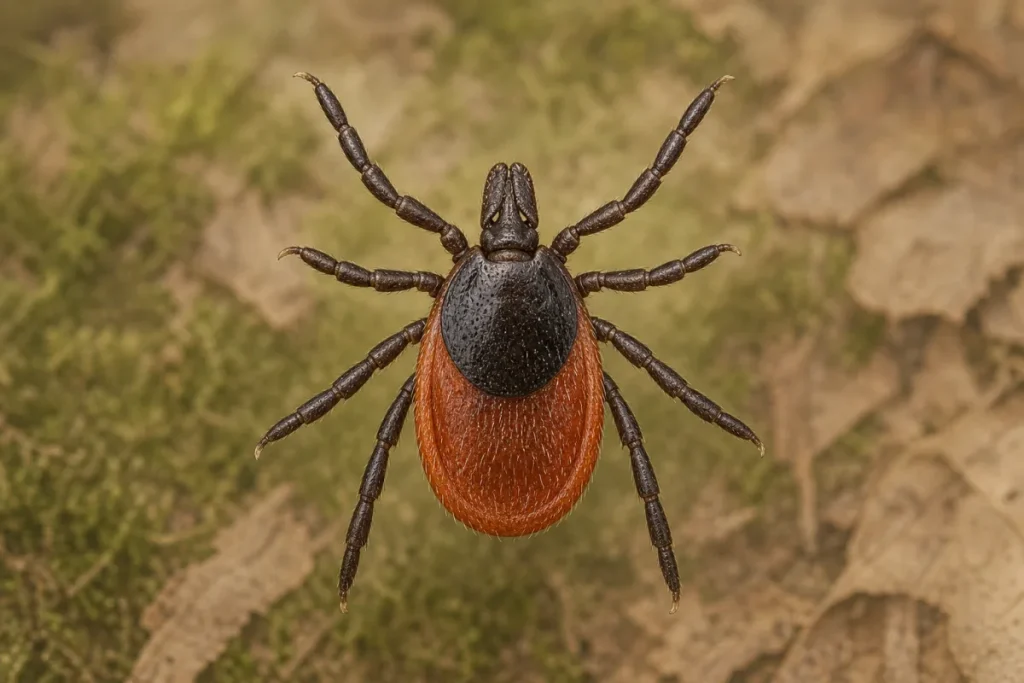
A black-and-red tick is often an unfed adult female blacklegged tick, also called a deer tick. A reddish-orange rear body around a dark shield, dark legs, and a compact oval shape are useful clues—but color alone cannot confirm the species or whether the tick can transmit a germ. Source (accessed 2026-11-06)
If the tick is attached, focus on safe removal rather than trying to identify it in place. Take a clear photo before or after removal if you can do so without delaying care. You can also compare its visible features with our deer tick identification page and tick appearance guide.
What a female blacklegged tick can look like
The familiar black-and-red appearance most closely matches an unfed adult female blacklegged tick. She may have a reddish-orange or brownish-orange abdomen, a dark scutum (the shield-like area near the head), and dark legs. Her mouthparts are relatively long and narrow. Feeding can greatly change the body’s size, shape, and color, so an engorged tick may no longer resemble the common black-and-red description. Source (accessed 2026-11-06)
- Adult female: often reddish-orange behind a dark front shield before feeding.
- Adult male: typically appears much darker overall because the dark shield covers most of the upper body; he may not look red.
- Nymph: much smaller and often dark brown, without the bold adult female color contrast.
- Larva: very small and difficult to identify from a casual photo.
Blacklegged ticks develop through larval, nymphal, and adult stages. Their appearance varies across those stages and after feeding, which is why a color-only identification can be misleading. Source (accessed 2026-11-06)
Compare a blacklegged tick with similar ticks
Use several traits together: body pattern, shield coverage, legs, mouthparts, size relative to a familiar object, and whether the tick has fed. A photo taken from directly above is usually more useful than a distant image of a tick on skin or fur.
| Feature | Often seen on a female blacklegged tick | Why it is not conclusive |
|---|---|---|
| Back color | Reddish-orange body with a dark front shield | Color changes with lighting, age, and feeding. |
| Legs | Dark legs | Other ticks can also have dark legs. |
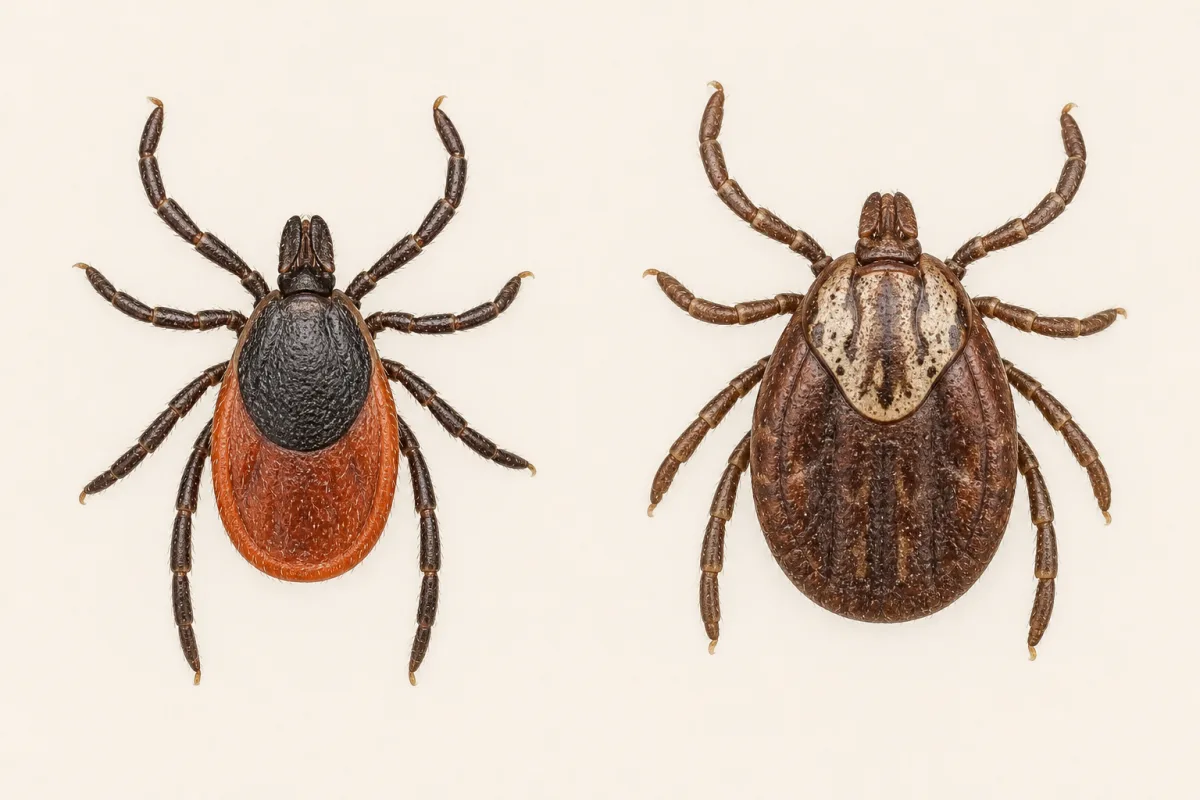
| Pattern | Usually lacks the ornate pale markings seen on some dog ticks | Damage, blur, and a fed body can hide markings. |
| Mouthparts | Long, narrow-looking mouthparts from above | They can be obscured by angle, skin, or fur. |
American dog ticks can be mistaken for blacklegged ticks at a glance, especially in low-quality photos. They are commonly more broadly oval and may show pale gray or whitish markings on the shield or upper body rather than the clean reddish-orange-and-dark contrast of an unfed female blacklegged tick. Compare the whole tick, not one color patch. For a size-focused comparison, see dog tick size.
Where you found a tick can narrow possibilities, but it does not prove the species. Blacklegged tick distribution, seasonal activity, and local disease patterns differ by region. A tick can also travel on people, pets, wildlife, clothing, or outdoor gear. Source (accessed 2026-11-06)
Are black-and-red ticks dangerous?
Color does not tell you whether a tick is infected or whether transmission occurred. Blacklegged ticks can spread pathogens that cause Lyme disease, and public-health risk depends on the species, local conditions, attachment, and other exposure details. Not every blacklegged tick carries a pathogen, and a tick’s appearance cannot diagnose illness. Source (accessed 2026-11-06)
After a bite, watch for symptoms rather than waiting for a tick identification alone to answer every health question. Fever, chills, fatigue, headache, muscle or joint aches, swollen lymph nodes, or a rash can warrant medical advice, especially after possible tick exposure. Seek urgent care for severe symptoms or if you feel seriously unwell. Source (accessed 2026-11-06)
What to do after finding a tick
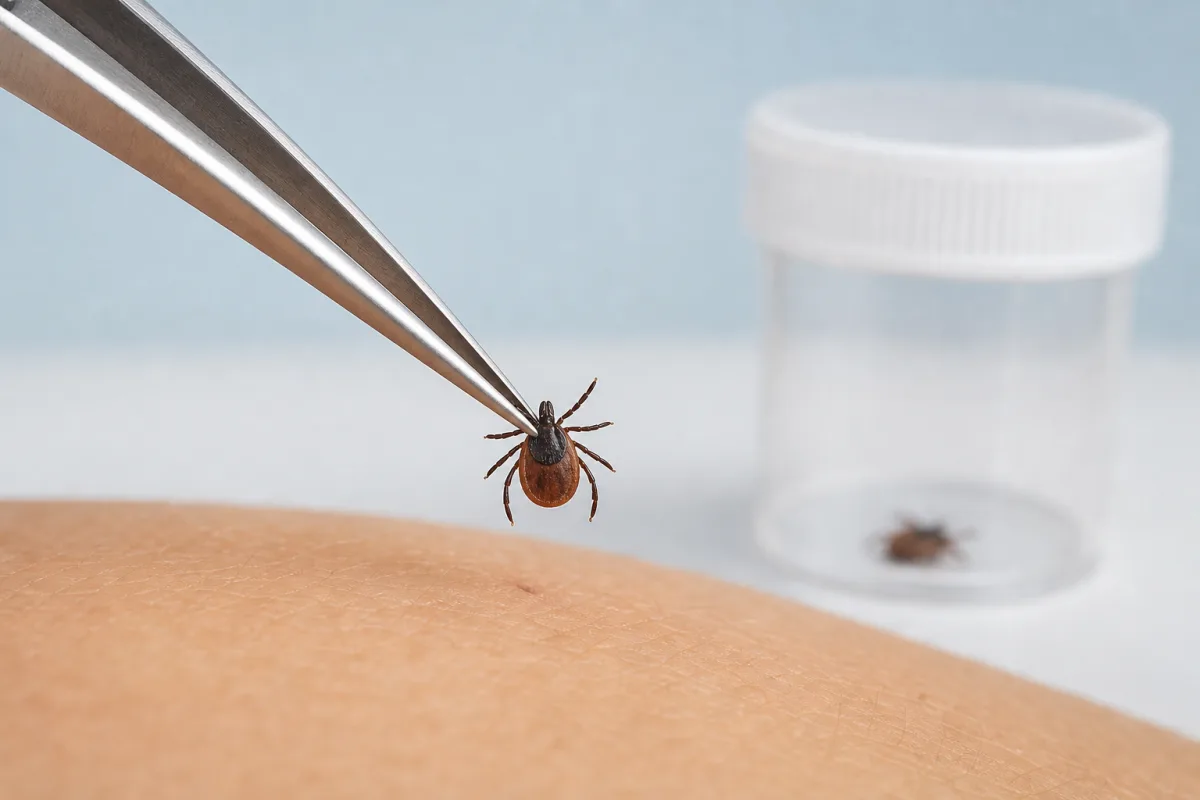
- Remove an attached tick promptly with clean, fine-tipped tweezers. Grasp it as close to the skin as possible and pull upward with steady, even pressure.
- Clean the bite area and your hands after removal.
- Place the tick in a sealed container or bag if identification may be useful. A photo beside a ruler or another scale reference can help.
- Record where and when it was found, whether it was attached, and whether it looked flat or swollen.
- Check pets and other household members. For pet-specific concerns, contact a veterinarian.
Do not use petroleum jelly, heat, nail polish, or other substances to try to make an attached tick detach. Those methods are not recommended for removal. Source (accessed 2026-11-06)
Get a more useful tick photo
Photograph the tick on a plain, well-lit surface after removal when possible. Include a clear top view, a side view if available, and a scale reference. Avoid compressing, crushing, or covering key features. A sharp image of the back and mouthpart area is more useful than a close crop of an indistinct dark shape.
Ticky is an app presented as a way to identify a tick from a photo. A photo-based result can support your next step, but an unclear image or an unusual specimen may still need expert confirmation. If you are unsure whether the tick is a blacklegged tick, preserve the specimen when practical and consult local public health, a qualified identifier, or a clinician for bite-related concerns. Source (accessed 2026-11-06)
For a careful skin, clothing, and pet check after outdoor time, use our tick check guide. If the tick was very small, our tiny tick guide explains why life stage can complicate identification.
Can a photo confirm a black-and-red tick?
A sharp, well-lit photo can reveal useful features, including body pattern, legs, shield shape, and visible mouthparts. It cannot always confirm species, particularly when the tick is fed, damaged, partially hidden, or photographed without scale.
Does every blacklegged tick transmit Lyme disease?
No. A tick’s color and species appearance do not reveal whether it carries a pathogen or whether transmission occurred. Discuss symptoms and exposure concerns with a healthcare professional. Source (accessed 2026-11-06)